Prices
- Free placement (qualifying sites)We own, stock and service the machine
- $0
- Refurbished drink machinePlus payment system and transport
- From $1,950 + GST
- New drink machinePlus payment system and transport
- From $4,950 + GST
- Cashless card readerTap, phone, watch and QR
- From $550 installed
- Used coin acceptorWhere cash acceptance is still wanted
- From $295 inc GST
Prices exclude GST unless stated. Transport is quoted on your postcode and site access.
Compare machine types and local buying guides
Drink vending machine pricing & ROI calculator
Set the drinks you expect to sell each day and see machine cost, monthly profit, payback and how often the machine needs refilling. Australian dollars, excluding GST.
Best payback on a proven site — from $1,950 + GST, holds about 380 drinks.
Drinks sold
Set-up cost
Payback period
2.0 months
Up-front outlay $2,750 recovered from monthly net profit.
- Drinks sold per month
- 750
- Monthly sales revenue
- $2,625
- Monthly stock cost
- $1,200
- Monthly site commission
- $0
- Monthly electricity
- $40
- Monthly net profit
- $1,385
- Year one profit after outlay
- $13,866
- Refills needed per month
- 2.0
- Days between refills
- 15.2
Cold drink sales climb sharply through an Australian summer. If your machine needs refilling more than twice a week, a larger glass-front machine usually earns more than a second small one.
AI-assisted estimate — please read: this calculator is an automated, AI-assisted tool, not a quote, valuation or financial advice. Just as humans make mistakes, so can AI — figures may be incomplete, out of date or wrong for your site, so treat every number as indicative only.
Actual results depend on site traffic, staff numbers, weather, product mix, retail pricing, power, commission and stocking. Figures exclude GST, and machine prices exclude GST, payment system and transport unless shown. Nothing here is an offer, contract or guarantee of sales, revenue, profit or payback, and we accept no liability for decisions made in reliance on it.
Confirm all pricing in writing on 0401 662 678 or sales@vending-machine.com.au before committing.
Three ways to get cold drinks on site
Every drink vending arrangement in Australia reduces to one of three deals: someone else owns the machine and takes the revenue, you rent the machine and keep the revenue, or you buy the machine and carry both the upside and the risk. Which one suits you depends far more on how much you want to be involved than on how big your site is.
Placement is the default for workplaces. Purchase suits operators, clubs and sites that want the margin. Rental sits between the two and is common where the drink revenue is genuinely worth having but nobody wants a capital purchase on the books.
| Free placement | Rental | Purchase | |
|---|---|---|---|
| Upfront cost | $0 | Monthly fee | From $1,950 + GST |
| Revenue | We keep it | You keep it | You keep it |
| Stocking | We do it | You or us | You |
| Repairs | We do | We do | You after warranty |
Getting summer right
Australian summers punish under-planned drink vending. Sales in a hot week can run at two to three times winter volume, and they arrive concentrated in a few hours around the middle of the day. A machine on a fixed fortnightly refill will simply be empty by Thursday, and an empty machine trains people to stop checking it.
The fix is boring but effective: telemetry on every machine, water and electrolyte facings increased before the season rather than after the first complaint, and refill frequency reviewed by site each month. Where a single machine cannot carry the peak, we would rather add a second unit than let the first run dry.
- Water is the number one line on nearly every Australian site
- Sugar-free and no-sugar lines now outsell full-sugar in most workplaces
- Electrolyte and energy drinks climb sharply on hot outdoor and shift sites
- Cold-drink demand peaks between 10am and 3pm
Machines we place and sell
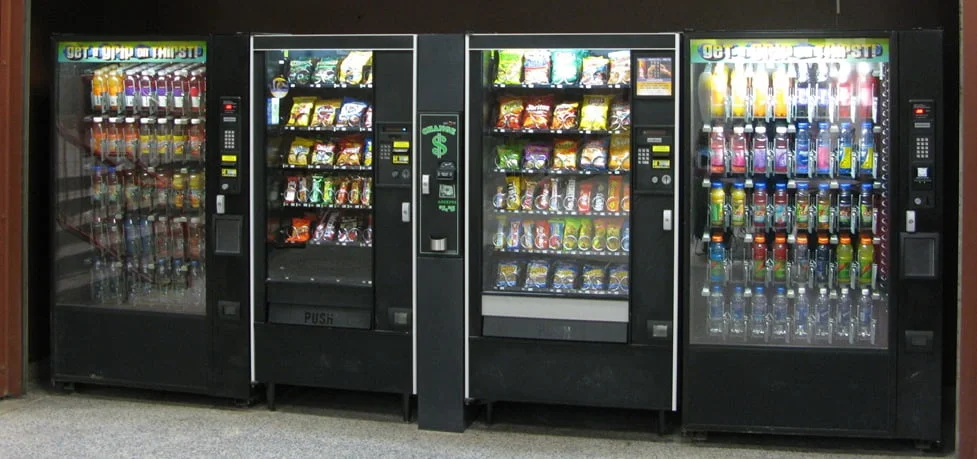
Refrigerated drink machines come as single-zone units for pure beverage sites, multi-zone units where chilled and ambient product share one cabinet, and combination machines that carry both drinks and snacks for smaller sites. Capacity ranges from around 250 to over 600 units depending on model and product size.
Every machine we place carries a cashless reader and remote monitoring as standard. Machines we sell can be specified the same way, and cashless can be retrofitted to most existing machines with an MDB controller.
What our service actually covers
The service behind the machine is what actually decides whether drink vending works on your site.
- Telemetry-driven restocking rather than fixed rosters
- Planogram built from your staff's choices, then tuned on real sales
- Temperature alerting so refrigeration faults are caught early
- Faults attended, staff refunds handled, machine cleaned inside and out
- Free relocation or removal on placed machines
Cold drinks vending machine: cans, bottles and chilled capacity
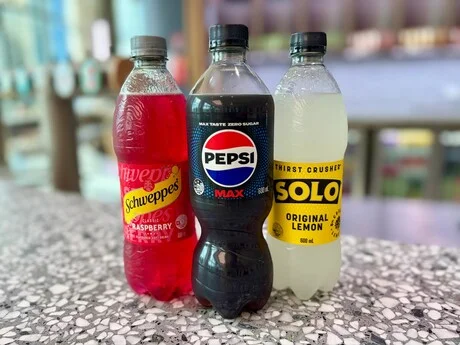
A cold drinks vending machine refrigerates packaged beverages and releases the selected product after payment. For a Australian workplace, the first decision is not the colour of the cabinet: it is which pack sizes must fit, how many drinks the machine can hold and who will refill it. Water bottles, soft-drink cans, iced tea and sports drinks have different shapes. Ask for a vend test with the actual packaging before agreeing to a particular tray, column or delivery mechanism. A machine advertised as bottle-ready may still require adjustment for your preferred bottle.
Choose the range from the people using the site rather than an assumed national bestseller list. Start with water and a mix of regular and no-sugar drinks, then review what actually sells. Give popular products more than one selection if stock-outs become common. Keep product labels visible and prices clear. Refrigeration capability should be checked against the manufacturer's operating limits, placement and ventilation requirements; a colder thermostat setting does not compensate for an unsuitable location or restricted airflow.
Drink snack vending machine: the best of both worlds?
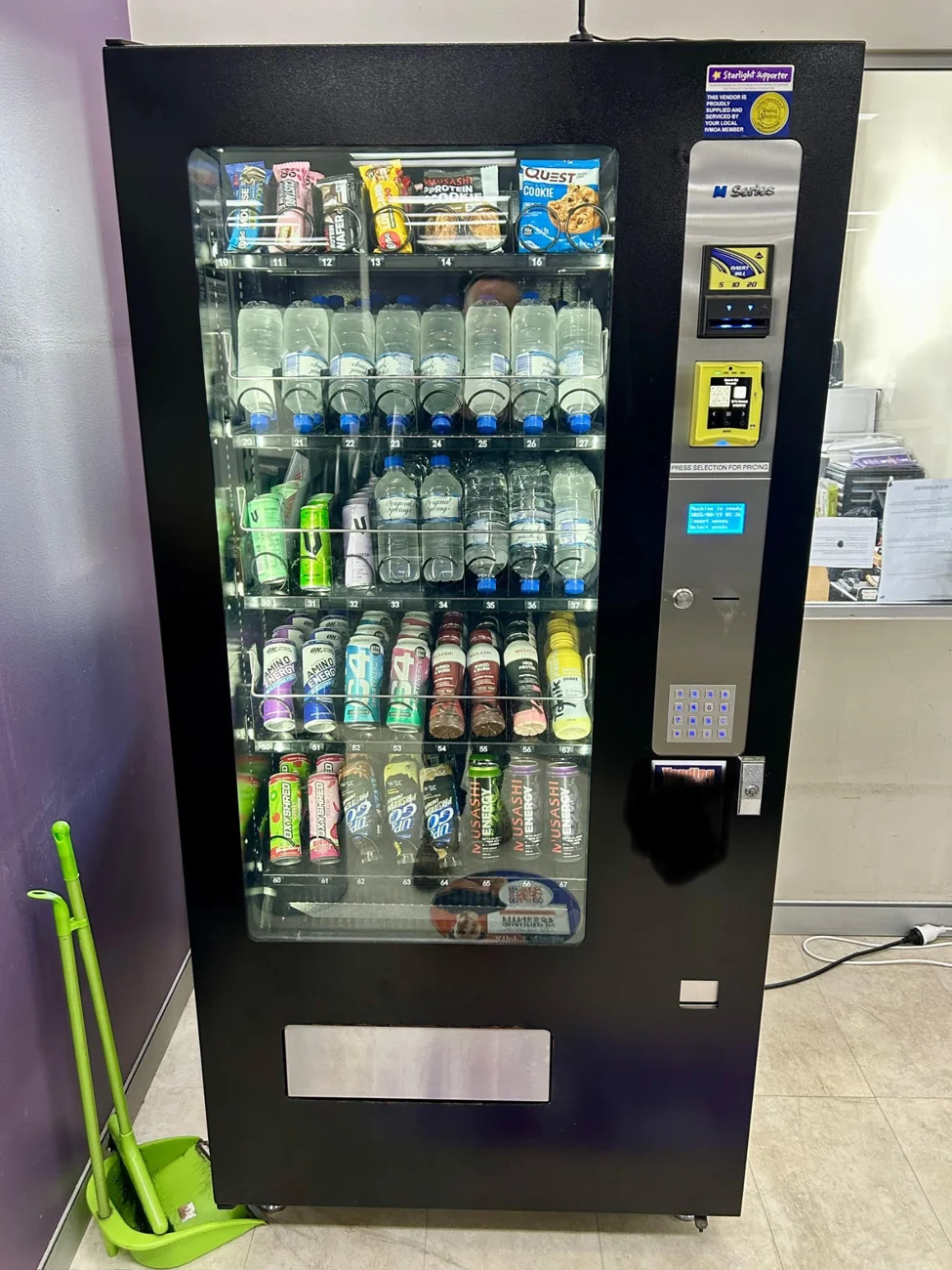
A drink snack vending machine puts packaged snacks and cold drinks into one cabinet. That can be the best of both worlds when a workplace wants refreshments but has room for only one machine. However, a combination cabinet shares its footprint between two ranges. Compare the number of drink positions, snack selections and usable stock depth, not just the total selection count. A busy break room may need separate drink and snack machines even when a combo initially looks cheaper.
Check the temperature arrangement for the exact model. Some combination machines refrigerate a shared cabinet; others use separate zones. Chocolate, chips, bars and bottled drinks do not all respond the same way to refrigeration. Ask which products the supplier recommends and whether shelves can be configured without obstructing the payment reader or collection bin. A combo machine is not automatically a fresh-food machine. If your plan includes sandwiches or meals, the food-safety specification needs a separate review before any stock is loaded.
Food and drink vending machines: packaged snacks versus fresh meals
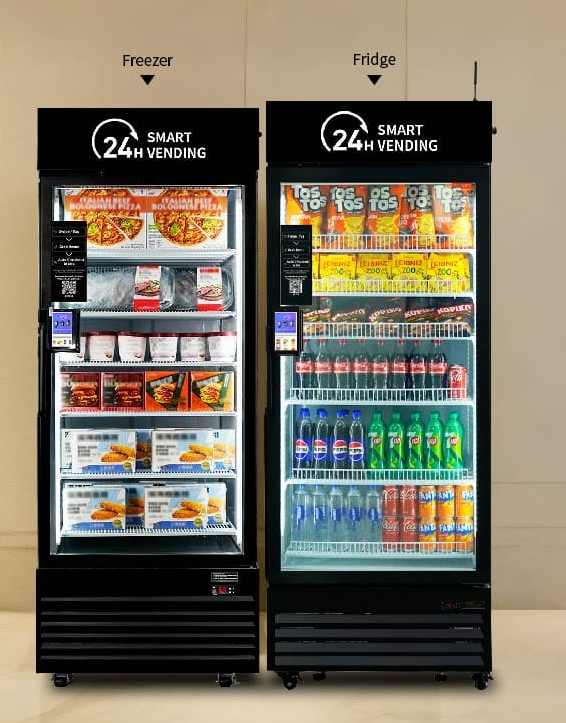
Food and drink vending machines can mean a snack-and-beverage combo, a chilled fresh-food cabinet, or a smart fridge holding meals and drinks. State which one you mean in your enquiry. Shelf-stable packaged snacks have different handling requirements from potentially hazardous chilled foods. A machine suitable for cans and crisps is not proof that it can safely sell sandwiches, dairy meals or salads unattended. Ask for temperature records, alarm behaviour, cleaning instructions and the process for preventing sales after a refrigeration fault.
Food Standards Australia New Zealand says potentially hazardous food generally needs to be kept at 5°C or colder, or 60°C or hotter, unless a safe alternative is demonstrated. Its two-hour/four-hour guidance relates to cumulative time between 5°C and 60°C, not a blanket permission to ignore refrigeration. Apply the relevant requirements to your products, transport, loading and display. Check with the local food regulator about registration and food-handler obligations. Assign responsibility for date rotation, temperature checks, recalls and disposal before launching a meal range.
Dispensing machines for sale: inspect new and refurbished options
Dispensing machines for sale is a broad phrase. For this guide it means vending machines selling packaged drinks, snacks and food, rather than water dispensers, industrial dosing equipment or medicine dispensers. Buying new usually gives access to current models and a stated manufacturer warranty. Buying refurbished can reduce the initial machine outlay, but the controller, refrigeration, payment compatibility and parts availability deserve inspection. Compare an identified machine and condition report rather than assuming every second-hand unit has received the same refurbishment.
Request the model, serial or stock identifier, dimensions, weight, power requirements and warranty scope. Ask what was tested and replaced, whether all selections vend correctly and whether the card reader is included. Read who pays for labour, freight and a technician visit if a fault occurs. A photograph should show the actual offered unit where possible, not merely a similar cabinet. Our model and specification pages support an initial shortlist; your written quote must confirm current availability, inclusions and the machine that will be delivered.
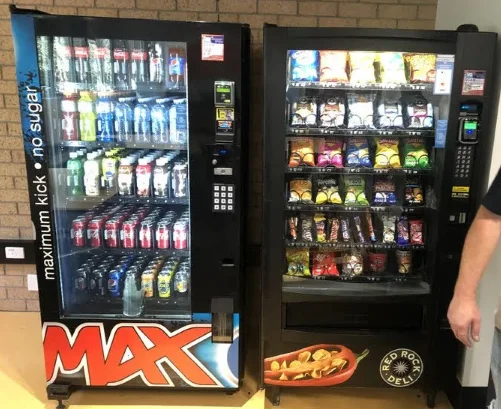
Compare free placement, ownership and lease-to-own
Free placement is a workplace amenity, not a promise of free drinks. The operator is paid from product sales. Around 30 people with daily access, or strong public foot traffic, is a starting eligibility guide; approval still depends on the site and the available service route. Buying gives you control over the machine and takings, but it also gives you stock costs, payment charges, repairs and the work of running it. Neither route is automatically better for every business.
Lease-to-own can spread the equipment cost instead of requiring the full purchase amount upfront. Terms depend on the equipment, applicant and finance agreement, so this page does not invent a weekly repayment or approval guarantee. Confirm the total payable, fees, tax treatment, what happens if you repay early and exactly when title transfers. Separately agree who stocks and services the machine during the term. Owning it later does not remove those operating responsibilities today.
| Option | Who owns and stocks it? | Before agreeing |
|---|---|---|
| Free workplace placement | Operator owns, stocks and services | Confirm eligibility, access and agreed product range |
| New or used purchase | Buyer owns; stocking and service must be arranged | Confirm itemised delivered price and warranty |
| Lease-to-own | Ownership transfers under the agreed finance terms | Confirm repayments, total payable and end-of-term conditions |
The real delivered cost, GST and ongoing service
Ask for separate lines for the machine, payment hardware, freight, positioning, setup and GST. The delivery examples supplied to us are Sydney metro approximately $220–$260 including GST, Sydney to Melbourne or Brisbane approximately $880 including GST, and Sydney to Adelaide approximately $920 including GST. These are indicative transport figures, not fixed offers for every address. Regional destinations, stairs, restricted docks, ferry crossings, lifting equipment and after-hours bookings need an individual freight quote. Machines are mainly based in Sydney, with some also in Melbourne.
There is no confirmed standard service fee to apply to every buyer. A calculator field at zero does not mean servicing is free on a purchased machine. Request the service arrangement and its price, including what is excluded. Keep power, stock purchases, payment subscriptions, transaction fees, cleaning and repairs separate from acquisition cost. Calculator results use entered figures; we cannot guarantee any figures, prices, profit or payback. Only an accepted written quote and the relevant agreement confirm your price and inclusions.
What to send for a useful written quote
Send the full Australian site address and postcode, daily attendance, shift hours, preferred products and whether you want free placement, a new purchase, a used machine or finance. Include photographs of the proposed position and delivery route. Measure the narrowest doorway, lift opening and usable lift space, and flag steps, parking restrictions and security inductions. Confirm there is a suitable electrical supply and that the machine will not block accessible circulation or emergency exits. The dimensions of one cabinet are not a universal installation specification.
Vending Machine publishes machine specifications, ownership comparisons and enquiry options at vending-machine.com.au so you can check the recommendation against your own requirements. We do not claim a staffed branch in every city or a guaranteed local response time. Ask us to confirm the delivery origin, service coverage for your postcode and the contact responsible for breakdowns. Keep the supplier's written answers with your purchasing records. That provides a more useful basis for a decision than a broad claim that a machine is the best in Australia.
Frequently asked questions
How much does a drink vending machine cost in Australia?
Nothing on a free placement. To buy, refurbished refrigerated drink machines start at $1,950 + GST and new machines from $4,950 + GST, in both cases plus a payment system (cashless from $550 installed) and transport.
What size site do we need for a free drink machine?
As a rule of thumb, around 30 or more people with daily on-site access, or strong public foot traffic. Shift-work and 24-hour sites often qualify with fewer people because trading runs across a longer day.
Which drinks sell best in Australian workplaces?
Chilled still water leads on almost every site, followed by no-sugar soft drink. Energy and electrolyte lines lift sharply on hot-weather, outdoor and shift-work sites.
Can a drink machine be card-only?
Yes. Many sites now run card-only machines so there is no cash on site at all, with tap card, phone, watch and QR payment supported.
How much power does a drink vending machine use?
Roughly 1.5 to 4 kWh a day — about $1.50 to $3.00 a week on typical commercial tariffs — depending on the model, ambient temperature and how busy the machine is.
Get cold drinks on site before summer hits
Tell us your location, headcount and access hours. We will confirm free placement eligibility or quote a machine to buy — usually the same business day.