Vending machines Australia wide — free program or buy outright
VMVending MachineFree or Buy · Australia

Running costs

Energy Efficient Drink Vending Machines

A modern refrigerated drink vending machine uses roughly 1.5 to 4 kWh a day, or about $1.50 to $3.00 a week on typical Australian commercial tariffs. LED lighting, ECO scheduling, better insulation and variable-speed compressors have cut consumption sharply against machines built ten or more years ago.

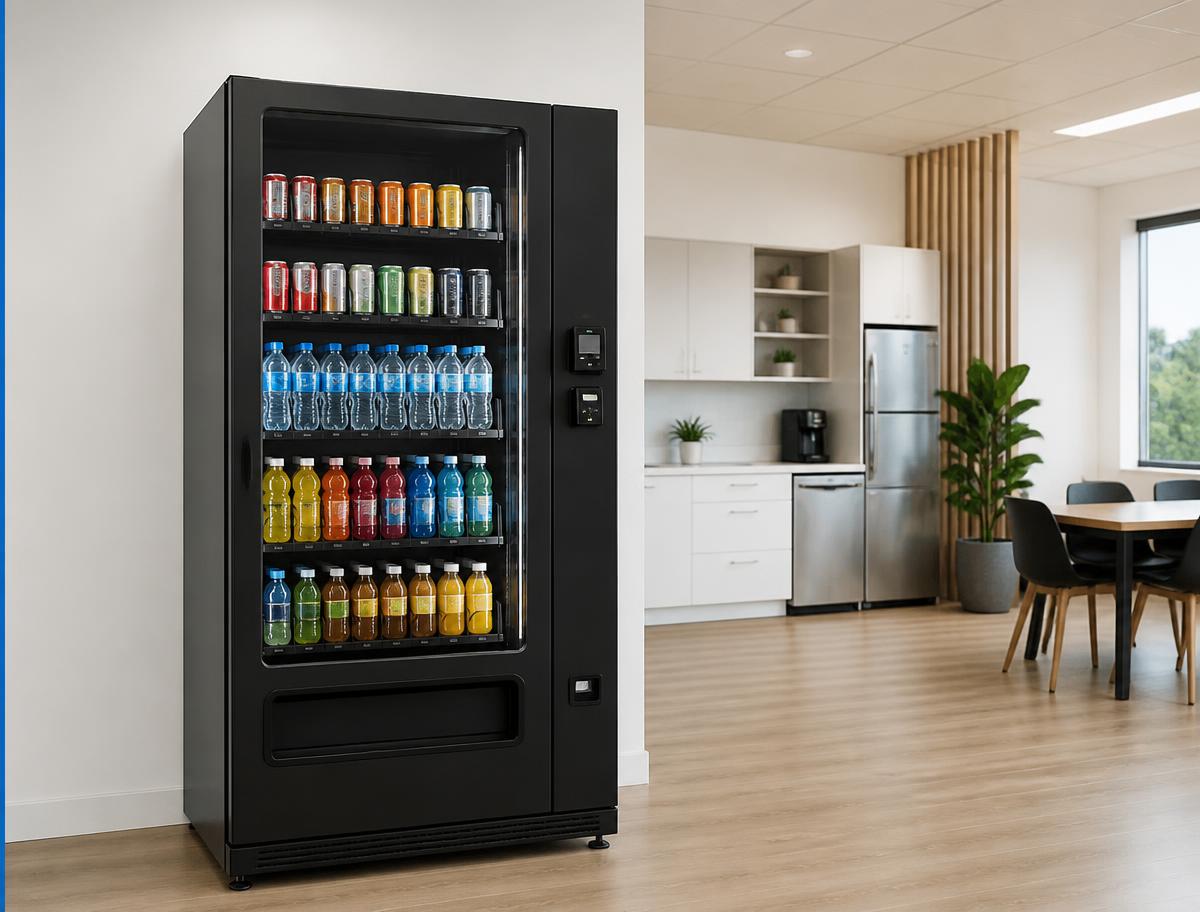
Glass-front cold drink vending machine with contactless card reader in an office break room
Cold drink vending for cans, bottles, water, juice and sports drinks.

Where the power actually goes

Refrigeration is the overwhelming majority of a drink machine's energy use, and its biggest driver is ambient temperature. A machine standing in an unshaded loading dock in a Queensland summer will use far more power than the same unit in an air-conditioned office, because the compressor runs longer to hold the same cabinet temperature.

The rest is lighting and controls. Fluorescent-lit machines from the 2000s burned meaningful power around the clock; LED conversions cut that portion by around 70% and run cooler, which reduces the refrigeration load as well.

Practical ways to cut consumption

On a purchased machine these steps typically pay for themselves within a season. On a placed machine, they are simply good practice — the site pays the power bill, so we set machines up for low consumption by default.

  • Position the machine indoors, out of direct sun and away from heat sources
  • Keep 75mm of clearance behind and above so the condenser can breathe
  • Clean condenser filters — a blocked filter is the most common cause of a power spike
  • Use ECO or night-setback scheduling on sites that do not trade 24 hours
  • Choose LED-lit models, or retrofit LED to an older machine
  • Run a single well-used machine rather than two half-empty ones

What our service actually covers

Efficiency is part of how we specify and maintain drink machines.

  • Model selection matched to your ambient conditions, not just capacity
  • LED lighting as standard on current models
  • ECO scheduling configured for your trading hours
  • Condenser cleaning built into service visits
  • Temperature telemetry so an inefficient machine is spotted early

Frequently asked questions

How much electricity does a drink vending machine use?

Roughly 1.5–4 kWh per day depending on the model, ambient temperature and how often the door is opened — about $1.50 to $3.00 a week on common commercial tariffs.

Are older second-hand machines expensive to run?

They can be. A pre-LED machine with an ageing compressor can use two to three times the power of a current model, which is worth factoring into a cheap purchase.

Can a drink machine run outdoors?

Only if it is rated for it and is under cover. Direct sun and rain shorten machine life and drive refrigeration costs up sharply.

Does turning the machine off overnight help?

Switching it off entirely is not recommended, because the cabinet has to pull the whole load back down each morning. ECO or setback scheduling is the better option.

Talk to us about a drink machine

Tell us your site, headcount and preferred drinks and we will come back with the best option — free placement, hire or purchase.

Machine sizes, specifications and PDF spec sheets

Every machine type we place free or sell outright, with real heights, widths, depths, weights, selection counts, capacity, power draw and temperature ranges. Measure your space against these figures before you order — 4 current models across 1 category. Most floor-standing machines are 1,830 mm high and need a single-phase 10 amp power point within two metres, plus about 100 mm clearance behind for airflow.

Every model has its own listing page with a large photo, full specs and a one-page PDF spec sheet you can hand to your electrician, builder or facilities manager — browse all 4 machine listings.

New machine supply, spare parts and national technician support come through our affiliation with Vending Specialists. We are affiliated with AVS, so every new machine quoted from this page is a current Australian-supplied model with local parts, manuals and technician support behind it.

Cold drink machines

Glass-front and stack drink machines for cans, PET bottles and water. Sized by shelf count and can capacity.

Cold drink machines — dimensions, capacity, power and temperature specifications
ModelBrandH x W x D (mm)WeightSelectionsCapacityPowerTemperatureSpec sheet
Crane MEDIA 2 BevMax (7 Wide / 9 Wide)Best-in-class capacity per footprint, pick-and-place delivery so bottles are not dropped.Crane Merchandising Systems1850 x 1,015 / 1,180 x 822247 / 333 kg35 – 45 drink selectionsVends 5 shelves of 600 ml bottlesSingle phase 10 ampProgrammable 0°C – 23°CPDF
Crane MEDIA BevMax (7 Wide / 9 Wide)Proven high-volume drink machine, full product visibility behind glass.Crane Merchandising Systems1830 x 990 / 1,194 x 813247 / 347 kg35 / 45 selections280 / 360 unitsSingle phase 10 ampRefrigerated glass frontPDF
Vendo G-Drink DR6Executive / MDB, electronic cooling control, strong energy rating for a chilled drink machine.Vendo (SandenVendo)1830 x 950 x 845295 kg6 per shelf, 5 standard shelves / 7 max, 30 – 42 selections336 x 330 ml cans or 240 x 500 ml PET230 V 50 Hz, 800 W max, 252 Wh/h, Energy Class A+2°C to +10°C, climate class N (+16°C to +32°C)PDF
Vendo V721 stack drink machineHighest can capacity on this list. Bottle-to-can conversion needs no shims. LED lighting optional.Vendo (SandenVendo)1830 x 1,003 x 883299 kg10 selections / 10 columns680 cans or 300 PET bottles≤ 3.9 kWh/day (DOE), 8 amp ratingRefrigerated stack, R-134a or CO2 optionPDF