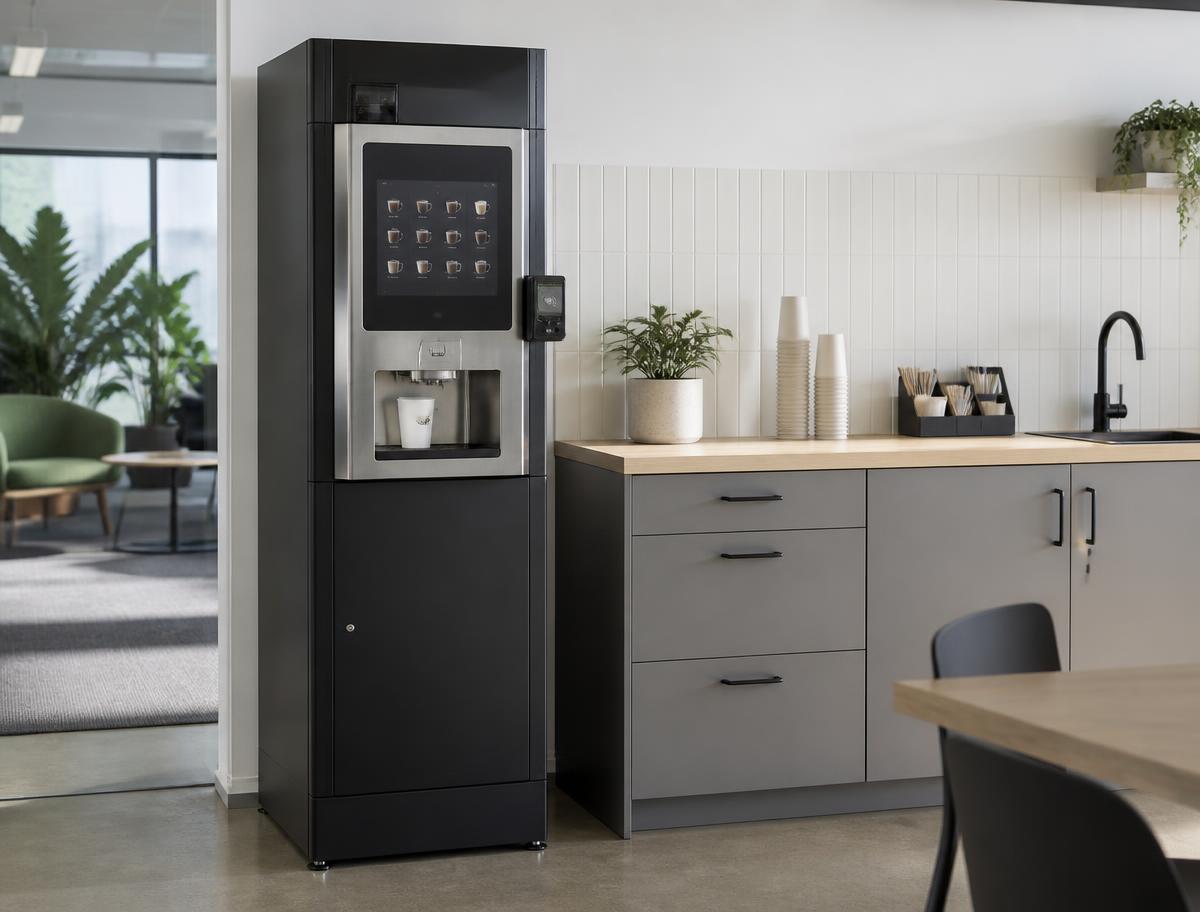
A staff benefit is not the same as paid vending
Begin by deciding who pays for each drink. In an employer-funded office kitchen, the equipment and consumables are workplace expenses. A benchtop bean-to-cup machine may provide suitable self-service coffee without payment hardware. In a visitor area charging per cup, you need a model designed for unattended payment, a merchant arrangement and a process for failed drinks. Do not compare those two installations as though the same headline price covers both.
Write down the intended menu before discussing models. Black coffee, flat whites and hot chocolate can involve different ingredient systems and serving times. Ask which drinks the exact quoted model makes, whether fresh milk or powder is used and which tasks remain manual. A catalogue photograph or the phrase barista-quality is not evidence of taste, throughput or fresh-milk capability. Request a demonstration or sample where practical, without assuming a particular machine is locally on display.
Adelaide city offices and Port Adelaide tenancies need different access briefs
For a multi-level city office, ask the property contact about receiving hours, dock bookings and the goods lift. In an older Port Adelaide tenancy, steps, narrow doors and permission to alter the kitchen may be the more important constraints. Council's Civic Precinct Plan provides heritage and mixed-use context for the Port; it does not tell you whether your own kitchen fits a machine or how many people will use it.
Measure bench depth, clearance beneath cupboards and room to remove water tanks, trays and grounds bins. For a freestanding cabinet, record the narrowest doorway and every turn from unloading to the final position. Tell the supplier about stairs before accepting freight pricing. A transport quote ending at the entrance is not equivalent to positioning and commissioning upstairs. Keep the agreed delivery scope with the quote so an attractive equipment price does not hide an unresolved installation job.
Use the busiest in-office day, not the payroll total
Hybrid attendance can make an average day misleading. Count the staff and guests who actually reach the kitchen on the busiest realistic day, then record cups wanted in the first break and after meetings. Ask for output on your expected milk drinks rather than only black coffee. A machine that handles a daily total comfortably can still produce an inconvenient queue when everyone arrives together.
If several floors or tenancies share facilities, prepare a separate reachable-user count for each coffee point. Compare one central machine with separate units only after including additional purchase, installation, cleaning and consumable storage. Do not count the same meeting guests twice. For a training room, record the session size and break duration separately from routine office use. These numbers help a supplier shortlist equipment; they are not a guarantee of sales, savings or a specific capacity requirement.
Water and milk decisions create recurring work
Tank-fed equipment avoids a permanent water connection but someone must replenish the tank. Plumbed equipment can reduce refilling but may need permission, filtration or drainage specified by the manufacturer. Ask the supplier to confirm requirements for the selected model and the site supply. Do not assume all Adelaide buildings need the same water treatment or that plumbing is included in a machine-only quote. Use qualified trades where required and confirm who arranges them.
Fresh milk needs appropriate refrigeration and the model's hygiene routine. Powder-based drinks still need cleaning, ingredient handling and waste removal. Assign these tasks to a responsible contact and cover leave, weekends and shutdowns. Ask for a handover showing cleaning cycles, safe restart and how to take the machine out of use after a fault. Automated drink preparation does not mean maintenance-free operation, and an equipment warranty does not replace daily care.
Ask for an Adelaide support plan alongside the purchase price
Give suppliers the same site postcode, drink menu, peak cups, payment preference, water arrangement and access measurements. Ask for the model, GST, dispatch origin, freight, unloading, positioning and commissioning separately. Confirm whether the installation includes a demonstration and initial configuration. If you have a fit-out deadline, ask the supplier to confirm availability and timing rather than reading a national catalogue as a stock reservation or a promised delivery date.
Get the fault contact and warranty scope in writing, including parts, labour, travel and any workshop-return freight. A supplier accepting Adelaide orders does not establish a technician in your suburb or a guaranteed response time. For rental or managed coffee, compare the full term cost, minimum ingredient purchases, cleaning visits and cancellation terms. Send the quote form your unresolved questions as well as the site brief; an enquiry opens a discussion and does not place an order.
Review the first office before expanding
Before equipping several Adelaide tenancies, agree how the first installation will be reviewed. Record actual cups, queues, water refills and cleaning time rather than copying a generic supplier forecast. Ask users about the menu, but compare feedback with usage and waste. Any trial, loan machine or taste session must be confirmed by the supplier; none is promised here. Keep measured kitchen constraints and the accepted menu with the buying decision so a future contact understands why the model was chosen.
A second office needs its own opening hours, permissions and reachable-user count. Confirm who receives ingredient deliveries and covers cleaning at each coffee point. Keep the accepted quote, manufacturer instructions and support contact accessible to the responsible person. If a tenancy changes, request a relocation assessment rather than assuming equipment can move without another access or water check. Use measured results to revise the brief; a suburb's business activity cannot guarantee demand or make every office installation suitable.
Keep the coffee quote separate from the combo package
The compact new coffee range starts at $990 ex GST ($1,089 including GST), before separately quoted delivery and installation. Larger paid coffee machines are priced by model. Budget ingredients, milk, cups, cleaning, electricity, servicing and payment fees where applicable. That compact starting price is not a complete freestanding paid vending installation.
New combo packages start at $4,990 ex GST including a credit card reader; delivery is separate. That package is not a coffee-machine quote and its reader inclusion does not automatically apply to coffee models. Ask David for a model-specific written offer using your actual site brief. An enquiry is not an order, stock reservation or confirmed installation date.
Frequently asked questions
What should a Adelaide coffee quote include?
The exact model, peak drink output, payment and milk system, water requirements, GST, freight, positioning, commissioning and postcode support should be confirmed in writing.
Does this mean there is a Vending Machine branch in Adelaide?
No. This is workplace buying and service-coverage guidance. No local partner showroom address is confirmed; ask the proposed supplier about appointments, delivery and support.
Request a coffee quote for your Adelaide workplace
Send David your postcode, attendance, peak cups and access brief for an itemised model-specific quote.