Industrial context is not a demand forecast
The Property Council's Adelaide industrial land report describes the role of employment land in manufacturing, storage and distribution. It explains why industrial workplace buying deserves a different brief from a city office, but it does not predict coffee use at your address. For Wingfield and Regency Park, count the people who can reach each intended lunchroom and the shifts when they are present. Keep office visitors separate from floor crews if they use different rooms.
Record break start times, break length and the longest gap between replenishment. A daily cup estimate is useful for ingredients, but simultaneous demand determines whether a queue fits the break. Ask for output on the actual drink mix, particularly milk drinks, and whether refilling interrupts service. Compare tank, bean or powder capacity and grounds-bin capacity as separate constraints. More selections or a larger touchscreen do not prove faster serving or a longer refill interval.
Put coffee in an approved lunchroom, not simply near the roller door
A large warehouse entry does not establish a safe coffee position. Ask site management to approve an indoor, level area separated from truck and forklift movement, dust and restricted production. Follow the model's temperature and ventilation instructions. If the lunchroom is not temperature-controlled, obtain the supplier's model-specific assessment rather than assuming refrigeration or hot-drink preparation works in every ambient condition. Keep circulation and emergency exits clear.
For delivery, identify the correct gate, unloading method and protected route to the final room. Include mezzanine stairs, narrow doors, thresholds and ramps in the access photos. Agree induction, contractor access and a handling window outside dispatch peaks. The site's forklift is not automatically suitable for moving the selected machine. Request a defined handling and commissioning scope from the supplier or transport provider rather than planning an improvised move by untrained people.
Separate a crew cabinet from administration coffee
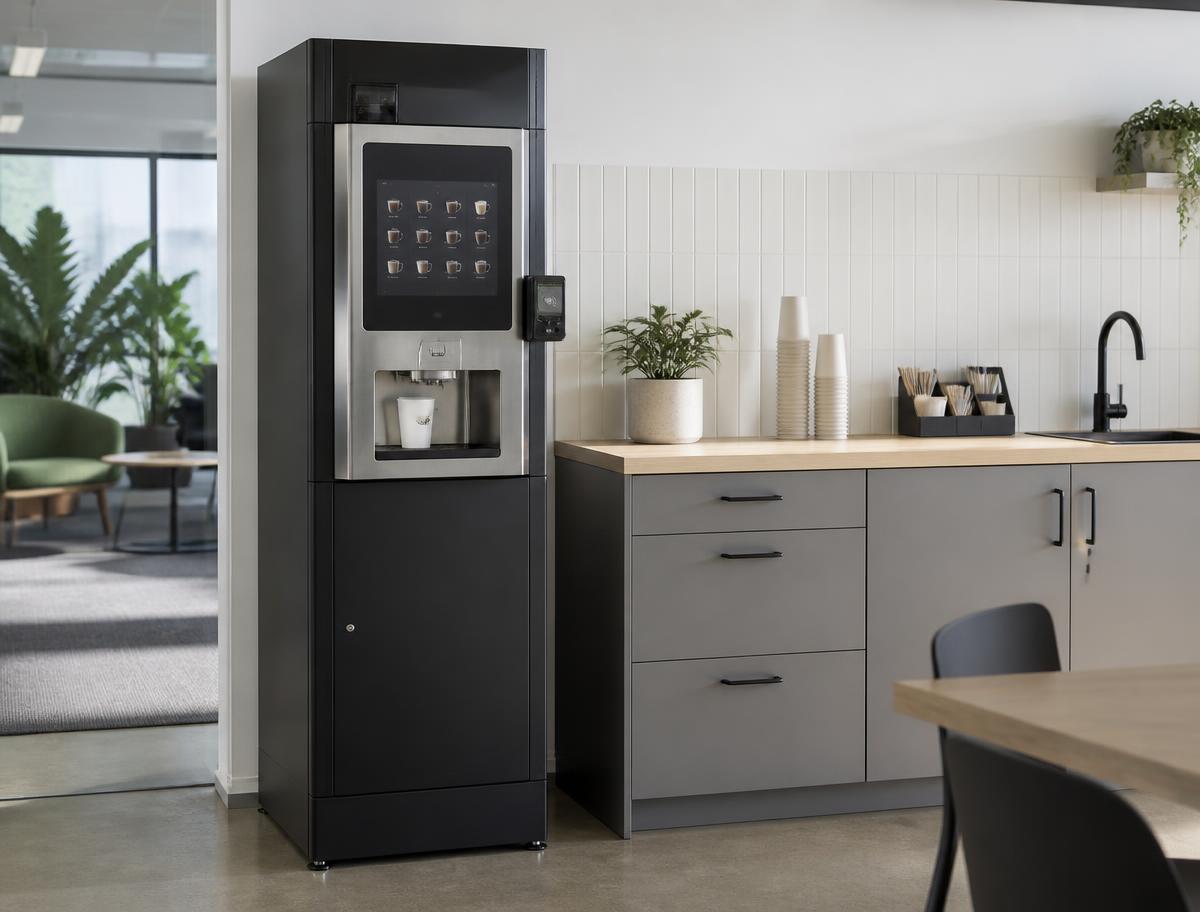
A compact employer-funded machine in administration and a paid freestanding cabinet in a crew lunchroom can solve different needs. Decide who pays before comparing equipment. Employer-funded cups belong in the operating budget, not a sales projection. For paid vending, confirm payment compatibility, provider fees, account setup and settlement arrangements. Test connectivity at the actual position rather than elsewhere in the depot, and name the person handling failed-vend refunds when administration is closed.
If crews occupy separate buildings, compare several coffee points with one shared machine using the same access and demand evidence. Additional units add cleaning, water, ingredients and repair responsibilities as well as purchase cost. Do not add a second cabinet merely because the whole-site headcount sounds large. Equally, do not assume everyone can walk to reception during a short break. Ask the supplier to show why the proposed model and number of units suit the reachable-user brief.
Late-shift refilling needs an actual owner
Name who replenishes beans or powder, cups and water before early crews arrive and after office staff leave. Give that person the manufacturer's cleaning and shutdown instructions. Fresh milk requires suitable refrigeration and hygiene; powdered drinks are not exempt from cleaning. Agree what happens during weekends, annual shutdowns and unexpected absence. If nobody can cover these jobs, discuss a written managed-service arrangement rather than assuming automated equipment performs its own daily care.
Keep the machine identification, support number and safe fault procedure with the shift contact. Ask how to isolate the unit or stop sales when a fault affects safe operation, and who authorises restarting it. Remote monitoring can identify a problem but does not physically refill a tank or remove waste. Confirm which alerts exist for the exact model and who receives them. A warranty covers its written terms, not every cleaning visit, ingredient shortage or immediate call-out.
Compare SA delivery and repair freight before accepting the quote
Ask where equipment dispatches from, who unloads it and who commissions it in Wingfield or Regency Park. Freight, positioning and installation should be separate named lines if separately charged. Provide postcode, quantity, dimensions and site access before requesting the delivered total. Stock and timing remain subject to the supplier's confirmation; the industrial report is not evidence that any coffee model is held locally or that a technician will attend immediately.
For repairs, identify parts coverage, labour, travel and workshop-return freight. Keep those answers alongside the purchase comparison. USED equipment needs current condition photographs, payment and drink testing, cleaning history and a clear support arrangement. FREE placement is an operator-managed assessment, not a zero-dollar ownership quote: the guideline is 25 people on site daily, with suitability and service-route availability assessed. Use the relevant enquiry form so David receives the right purpose and site details.
Review each Adelaide shift separately
After commissioning a Wingfield or Regency Park coffee point, record actual queues by crew break and note ingredient or water shortages. Keep front-office use separate from production demand where teams have different machines. If late shift repeatedly finds an empty tank, check refill responsibility and access times before buying a larger unit. Menu changes can alter output and cleaning work, so ask the supplier to review the actual settings rather than treating every drink as identical demand.
Store model instructions and support terms with the contact who can authorise a service visit. Record faults, refunds and periods out of use so recurring problems can be explained clearly. If production schedules change, update the operating brief before adding equipment. A second building needs its own approved position, delivery route and daily-care plan. The industrial report is context only; operating decisions should rely on measured workplace use and the selected model's requirements, not a suburb-wide employment figure.
Keep the coffee quote separate from the combo package
The compact new coffee range starts at $990 ex GST ($1,089 including GST), before separately quoted delivery and installation. Larger paid coffee machines are priced by model. Budget ingredients, milk, cups, cleaning, electricity, servicing and payment fees where applicable. That compact starting price is not a complete freestanding paid vending installation.
New combo packages start at $4,990 ex GST including a credit card reader; delivery is separate. That package is not a coffee-machine quote and its reader inclusion does not automatically apply to coffee models. Ask David for a model-specific written offer using your actual site brief. An enquiry is not an order, stock reservation or confirmed installation date.
Frequently asked questions
What should a Adelaide coffee quote include?
The exact model, peak drink output, payment and milk system, water requirements, GST, freight, positioning, commissioning and postcode support should be confirmed in writing.
Does this mean there is a Vending Machine branch in Adelaide?
No. This is workplace buying and service-coverage guidance. No local partner showroom address is confirmed; ask the proposed supplier about appointments, delivery and support.
Request a coffee quote for your Adelaide workplace
Send David your postcode, attendance, peak cups and access brief for an itemised model-specific quote.