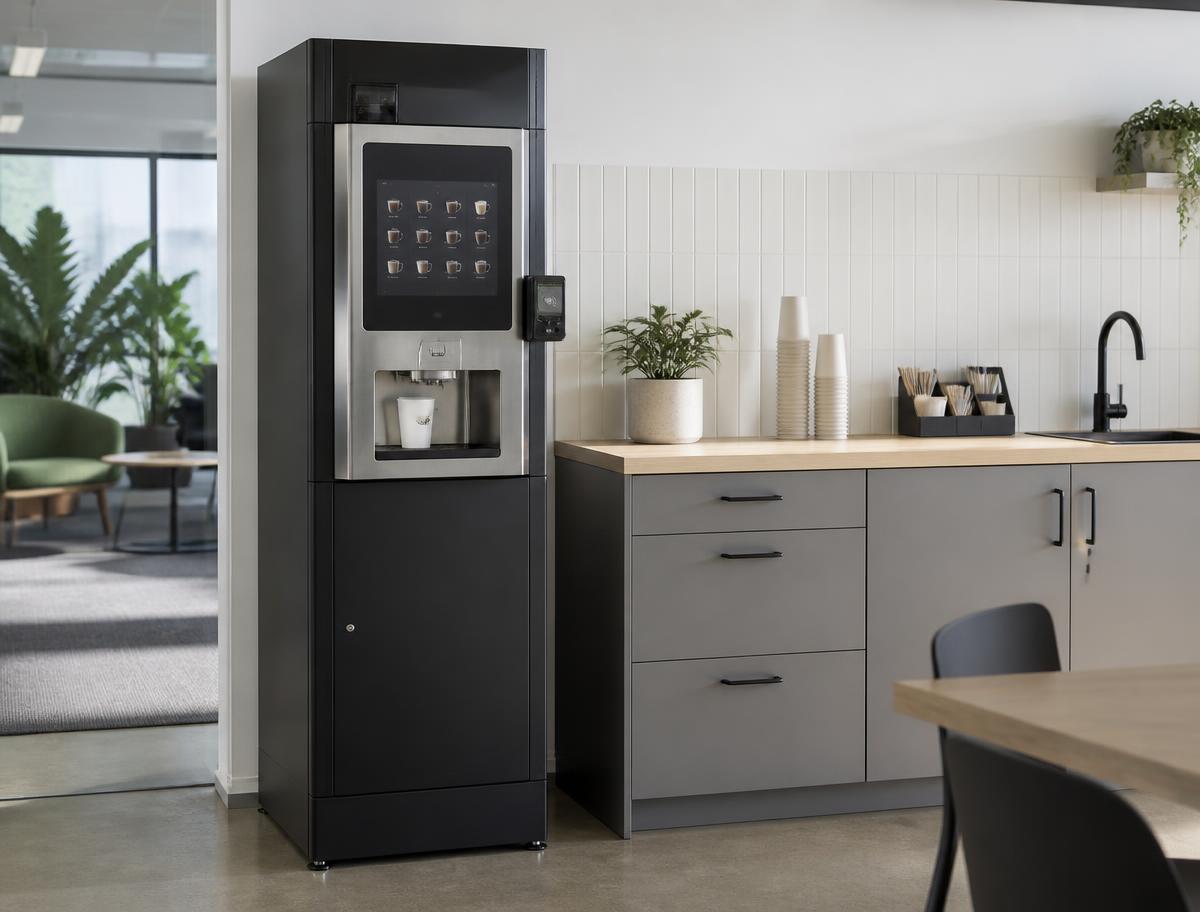
Map the break pattern before choosing equipment
Wetherill Park and Seven Hills workplace enquiries should separate office attendance from floor staff and visitors. A headcount of everyone employed is not the number who can reach the coffee area. Record shift overlap, the length of the busiest break and whether people can leave their work area. A short burst of cups can require more output than a larger office with staggered use.
Ask the supplier about the proposed model's actual brewing rate and recovery, usable water capacity, grounds-bin size and ingredient capacity. Do not infer those figures from the size of the cabinet or touchscreen. If the site has two isolated break rooms, compare two machines with one central machine and account for walking time, access and the additional cleaning workload. No machine capacity guarantees that people will buy coffee.
Choose paid coffee or an employer-funded benefit
Paid vending needs a model configured for payment and a clear refund process. Test card connectivity in the final lunchroom position, not at reception, and request the provider's transaction and data fees. A reader's hardware price is separate from its ongoing charges. Confirm who owns the merchant account and who reconciles settlements if the business operates the machine itself.
An employer-funded coffee point instead needs an ingredient and maintenance budget without assuming revenue. A compact benchtop unit can suit a smaller team; a larger freestanding machine may suit a busy shared area. Free placement is a separate suitability assessment, not a free purchase or free drinks. Keep that intention clear when enquiring so a buying quote is not confused with an operator-managed placement application.
Keep the position safe and serviceable
Describe dust, heat, vehicle movements and the distance from the production area. Choose an indoor position suitable for the actual model, away from forklift routes and protected from exposed conditions. Confirm ventilation clearances and power requirements in the installation instructions. The machine must not obstruct exits, pedestrian circulation or access to other workplace facilities.
Trace the route from the unloading area to the lunchroom. Flag roller-door thresholds, narrow pedestrian doors, ramps, steps and floor conditions. Ask who unloads and positions the cabinet and what handling equipment is required. Provide photographs before freight is booked. A supplier premises in the same suburb does not make positioning free or mean the machine can be delivered through any loading entrance.
Plan replenishment when the office is closed
A night shift needs someone able to refill water or ingredients, empty grounds and respond to a fault when the day office is locked. Name that person or confirm an operator's service arrangement. Fresh-milk and powdered-milk systems have different routines, but both need cleaning. Follow the model's instructions and agree what happens during shutdowns, weekends and public holidays.
Estimate ingredients from cups rather than attendance alone. Review actual consumption after installation, then adjust ordering and refill intervals. Keep cleaning supplies accessible to authorised people and record repeated faults so the supplier has useful information. Remote monitoring can assist where supported; it does not replace the physical refill and maintenance work. Ask what happens if a breakdown occurs just before a shift change.
Use real premises as citations, not invented suburb branches
Proto-Vend's published Sydney factory address is Unit Q17, 2 Cowpasture Place, Wetherill Park NSW 2164. AVS AutoVending (Automatic Vending Specialists) publishes 2/24 Prince William Drive, Seven Hills NSW 2147. David identifies these as related and affiliated supplier premises. AVS manages its own listing, and no extra Google Business listing is created for a warehouse enquiry.
Confirm appointments, coffee-model availability and postcode servicing with the named business. The cited addresses establish where those businesses say they operate, not a promise of same-day service at Eastern Creek, Smithfield or another suburb. This article covers workplace buying considerations and does not turn any customer's factory into a Vending Machine branch.
Request an itemised warehouse coffee quote
The compact coffee range starts at $990 ex GST ($1,089 including GST), while larger paid machines require a model-specific price. Quote freight, unloading, positioning, commissioning and any water or electrical work separately. Ask about parts, labour and travel under the warranty. Include recurring ingredients, cleaning, repairs and payment charges when assessing the total operating cost.
Send the site postcode, shifts, daily and peak cups, preferred payment approach, milk and water setup, measurements and delivery route through the NEW enquiry form. For a broader site, describe drink and snack requirements separately rather than treating a coffee machine as a combo cabinet. Ask for a written offer before ordering; availability, delivery and support are confirmed for your actual workplace, not inferred from a citywide advertisement.
Frequently asked questions
Does the compact coffee starting price include installation?
No. The $990 ex-GST compact coffee starting price excludes separately quoted delivery and installation. Larger paid models and payment hardware need model-specific inclusions.
Does a supplier's address guarantee local service?
No. Confirm the technician, coverage, response process, warranty scope and any travel or workshop freight for your postcode in writing.
Get a written coffee quote for your Sydney workplace
Send David your suburb, daily and peak cups, payment preference and delivery access. An enquiry is not an order.